Civic Museum of Cuneo - The Church
The story
Following an initial chapel built by the Franciscans at the end of the 13th century and a 14th-century phase revealed by recent excavations, a new and large religious monument was constructed in the historic heart of Cuneo in the early 15th century. Families and groups associated with the brothers immediately began to patronize the altars and decorate the chapels. In 1583, Monsignor Gerolamo Scarampi saw a rich and complete building, with altars decorated with sacred icons and frescoed chapels.
In the 17th century, the portico of the western cloister was rebuilt, the lunettes were frescoed with Stories of Saint Francis, and several chapels in typical Baroque style were added to the church.
The end of the eighteenth century marked the monument's most troubled period: after extensive renovations, the Napoleonic government requisitioned the church and used it as a military quarters. These years also saw the loss and dispersal of many of the monument's precious furnishings and the nearby convent, which was finally abandoned by the Franciscan Friars Minor in 1851, the year the already small convent community was suppressed. The Cuneo Military District established its headquarters in the convent's cloister, using the church as a warehouse.
The first restorations were carried out in 1928-1929, focusing primarily on the façade. The municipality purchased the building in 1967 and immediately undertook a general renovation and restoration project. The city administration again funded further restoration and archaeological excavation projects in the 1970s and 1980s.
The Church of San Francesco is now accessible following a long series of renovation and restoration works, begun in 2009, carried out thanks to the generous contribution of the Cassa di Risparmio di Cuneo Foundation and directed by the Superintendencies for Architectural Heritage, for Historical and Artistic Heritage, and for Archaeological Heritage of Piedmont.
The facade
A complex process, spanning half a century, marked the construction of the monument's façade. In 1481, the Zabreri brothers of Pagliero delivered the stone portal, simple yet distinguished by the still visible city coats of arms. A few years later, a series of decorative terracotta elements were added to finish the upper cornices and pinnacles. The Sormano brothers of Como were most likely responsible for the addition of the cherubs and candelabras present in the upper part of the structure. It is also hypothesized that the lunette above the door, now lost, contained a bas-relief, perhaps depicting an enthroned Madonna or Saint Francis himself, whose disappearance was reported by Monsignor Alfonso Maria Riberi in the early decades of the twentieth century.
The facade underwent a comprehensive restoration project in the early 2000s.
The archaeological excavation
The interior of the church, divided into three naves, is highly emotionally impactful. The left side section leaves part of the archaeological excavation exposed, accessible via a glass walkway. An active and engaging approach reveals the remains of the older church, highlighting the junction between the two buildings along the current perimeter wall. Recent extensive excavation of the building revealed two floors made of cocciopesto and mortar, dating to two different phases of the 14th-century structure, and numerous coffin tombs outside the southern wall of the church. Some of these likely contained furnishings and above-ground chapels and were sheltered by a portico. In addition to the numerous burials related to the early 15th-century structure of the building, further novel findings have emerged near the main apse of the current church, the fulcrum from which the reconstruction of the complex began in the first decade of the 15th century, with the discovery of a bell-casting plant. A similar artisanal arrangement, unearthed in the central nave, near the façade, is of later date. The investigation revealed multiple family tombs, which are currently being studied in the seventeenth-century side chapels as well.
The pictorial cycle
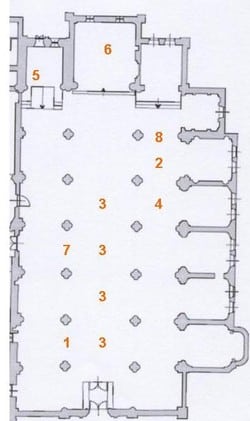
The recent restoration of the decorative apparatus has allowed us to complete the figurative discourse already masterfully conducted by Pietro da Saluzzo with his Stories of the Passion, depicted in 1472 on the ceiling of the so-called “Cruciata”, dedicated to the Confraternity of Santa Croce. To these are added the Saint Francis and the Saint Bartholomew now recovered in the archway of the second chapel on the left (1), dedicated to the Holy Innocents, which can be traced back to the early style of Pietro da Saluzzo, as well as the fragments on the second pillar of the left nave, depicting a Saint Michael and a holy bishop.
The most surprising discovery, however, is the entire decoration of the fifth chapel of the right nave, dedicated to San Bonaventura and frescoed with the Doctors of the Church (2), portrayed in studios furnished with chairs, furniture and accessories. The style is that of a later Pietro da Saluzzo, alongside the personality of another painter, to whom can be attributed details previously not found in the Pocapaglia workshop.
The decorations with polychrome geometric motifs that emerged from the vaults of the main nave (3) and of the chapel of the name of Jesus (fourth of the right nave, 4) can be attributed to the latter .
Finally, on the left wall of the chapel below the bell tower, a frescoed panel has now been recovered, surmounted by an angel next to a tower. Inside is a series of quadrilobes arranged in a semicircle with Christ Blessing in the centre and some saints with phylacteries on the sides. Below is a holy bishop within a quadrilobed niche flanked by another figure. The style of the work harks back to the linear Gothic of the early 15th century (5).
Furnishings and celebrations
The large central nave draws the visitor's gaze towards the terminal apse which in ancient times housed the famous fifteenth-century crucifix, of which there is now a plaster cast on a solid wooden cross (6).
The reopening of the monument to the public is also an opportunity to replace on the floor two of the commemorative plaques which were commissioned and introduced into the Church in the seventeenth century by notable families of the time: the Corvo and the Malopera.
In the left nave, today under the glass of the archaeological excavation, the sepulchral and celebratory epigraph of Massimiliano Corvo, dated 1623, is visible (7). And again, in front of the Mocchia chapel, the last one in the right nave, there is the funerary monument of the Jerusalem knight Gasparre Malopera, created between 1547 and 1678 AD (8).