History
History
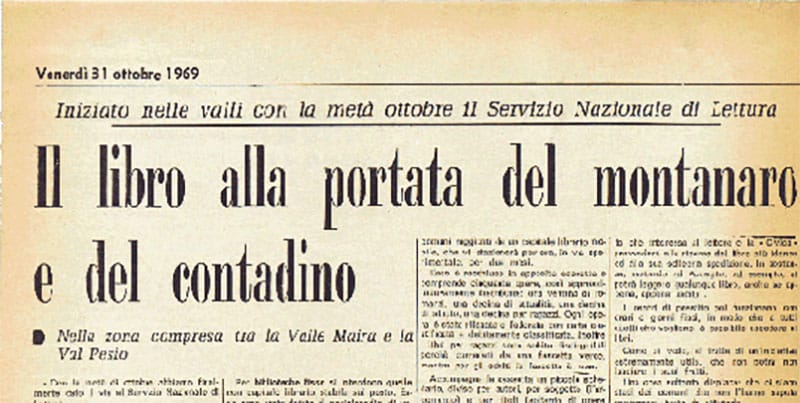
The Cuneo Library System was established on July 16, 1981, with Regional Council Resolution No. 48-8514, although its earliest traces date back to October 1, 1968, when the Cuneo Civic Library was entrusted with organizing the National Reading Service in the Cuneo area. The service's territory included (and still includes) the Pesio, Vermenagna, Gesso, Stura, Grana, and Maira valleys, as well as a small plain. Some existing civic libraries became part of the Cuneo Library System, while others, established later, were added at a later date.
The Civic Library of Cuneo, given the richness of its bibliographic heritage and its location in the territory, was declared a Central Network Library.
Piero Camilla was then appointed head of the Service and dedicated himself to fulfilling the tasks assigned to him: developing the public reading service to reach as many users as possible and, at the same time, moving the civic libraries out of their isolation and into a more dynamic environment open to mutual collaboration.
The presence of a large number of mountain communities in the area, lacking the resources necessary to open their own libraries, prompted Professor Camilla to open numerous lending offices in the most disadvantaged areas, supported quarterly by the Biblioteca Centro Rete. This phase can be considered, in a certain sense, the "pioneering" period of the Service: it involved identifying offices and managers in towns that were largely abandoned and severely affected by depopulation.
The people who agreed to run the service were extremely diverse: the teacher, the post office clerk, the parish priest, the town messenger, the tavern manager. Sometimes they even provided the location: the school, the town office, the rectory, a corner of the tavern. They all shared the same goal: to ensure that their town, through reading, would not be completely excluded from the cultural life that continued to unfold elsewhere.
Alongside libraries and lending offices, numerous reading centers were gradually established. Some of these opened in the outskirts and hamlets of Cuneo (Passatore, Donatello, Cuneo Sud), others in barracks, municipal retirement homes, the Cerialdo prison, and so on. The National Reading Service reached its peak between 1973 and 1975, when 45 municipalities in the Cuneo area and, albeit temporarily, 14 municipalities in the Mondovì area joined it.
The service's situation changed radically in 1978 when the Piedmont Region, through Regional Law 78/78, established the Library Systems. These became the de facto "heirs" and continuers of the National Reading Service, financially funded by the Piedmont Region, and were able to relaunch the service, which had slowed down due to a legislative vacuum that lasted from 1972 to 1978. The Library System of the Cuneo Valleys (as it was then called) continued to manage the service under the direction of Mario Cordero, who replaced Piero Camilla in 1978.
The activities carried out in the following years were primarily focused on maintaining the "traditional" services provided by the Centro Rete Library, promoting reading, and gradually computerizing its services. Among the noteworthy aspects that characterized that period, we recall some:
- between 1990 and 1995, four municipalities, thanks to a greater commitment undertaken by the Administrations and an improvement in services, decided to transform their lending office into a civic library, thus providing a tangible sign of the qualitative growth that had taken place;
- Centralized cataloging, considered one of the most useful services provided by the Network Center, was radically transformed when, in 1996, the Cuneo Civic Library joined the National Library Service (a telematic network of Italian libraries with participatory cataloging). Consequently, since then, the associated libraries have also benefited from this service, which allows (among other things) online consultation of the participating libraries' online catalogs;
- In 1997, a new agreement was signed between the Municipality of Cuneo and the Piedmont Region regarding the operation of the System. Among its most significant aspects were the development of the National Library Service throughout the region and a new form of contribution between participating municipalities and the Biblioteca Centro Rete;
- In June 2003, the Municipality of Cuneo signed a new agreement with the Piedmont Region. The new text, while introducing some significant organizational and administrative changes compared to the previous agreement, does not differ in terms of the objectives and tasks to be achieved;
- In December 2013, the Cuneo Library System launched a digital lendingto make it easier for its users to access information resources. The Media Library On Line offers all System users a vast array of digital materials: ebooks, periodicals, audio files, videos, audiobooks, and much more.
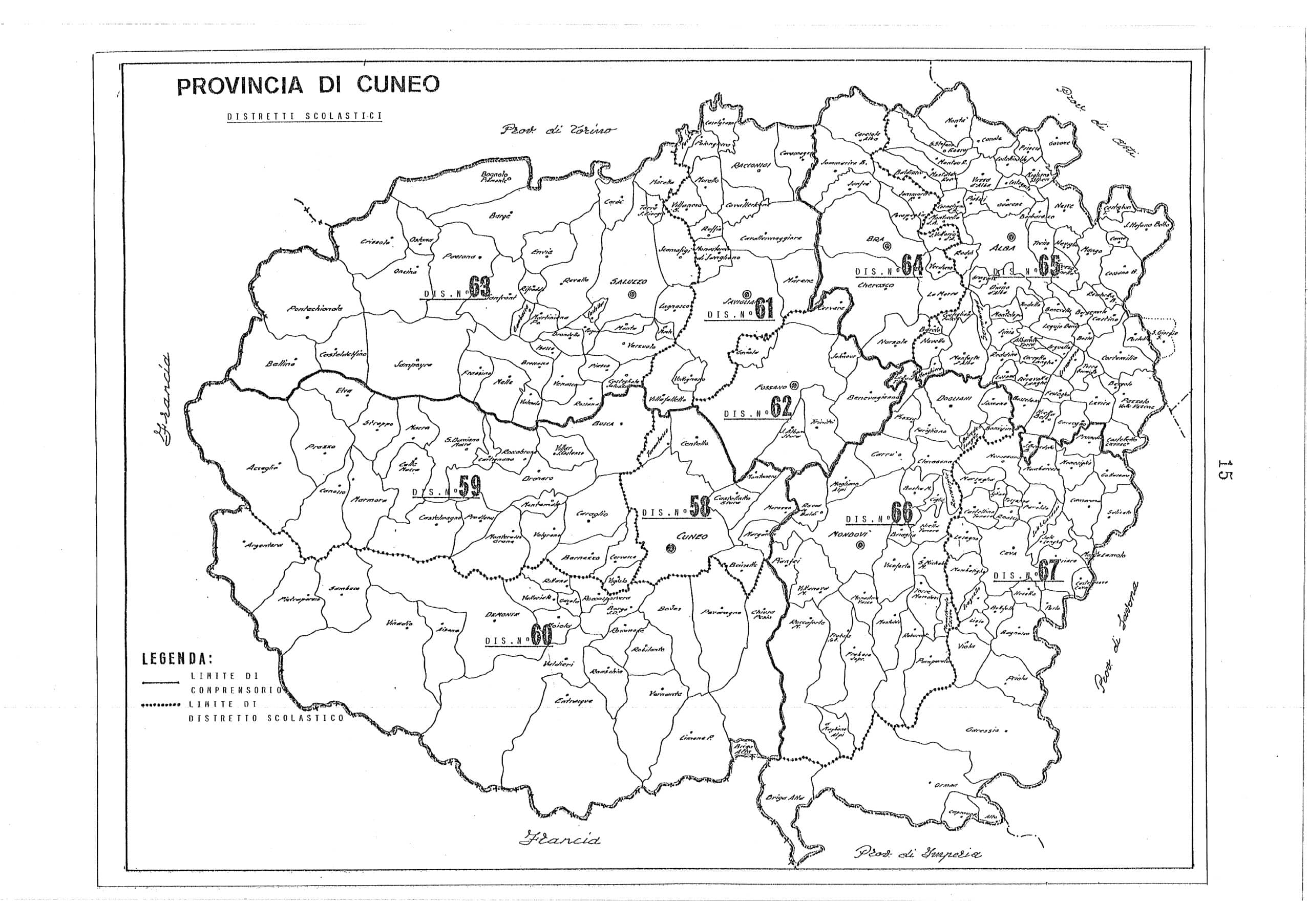
The Cuneo Library System currently coincides territorially with the former School Districts 58, 59, and 60 and is composed of the Cuneo Central Network Library, 19 civic libraries, 9 specialized libraries, and 17 lending locations. The System's main objectives are:
- to spread and strengthen the public reading service in the area under its jurisdiction;
- promote the optimal use of the existing book heritage in the System;
- raise the level of professionalism of library staff and, at the same time, improve the quality of the services provided;
- continue cataloging in SBN, thus promoting the dissemination of bibliographic information at an electronic level.
The Cuneo Civic Library continues its commitment, in collaboration with all participating libraries, to provide a service increasingly tailored to the needs and requests of readers.