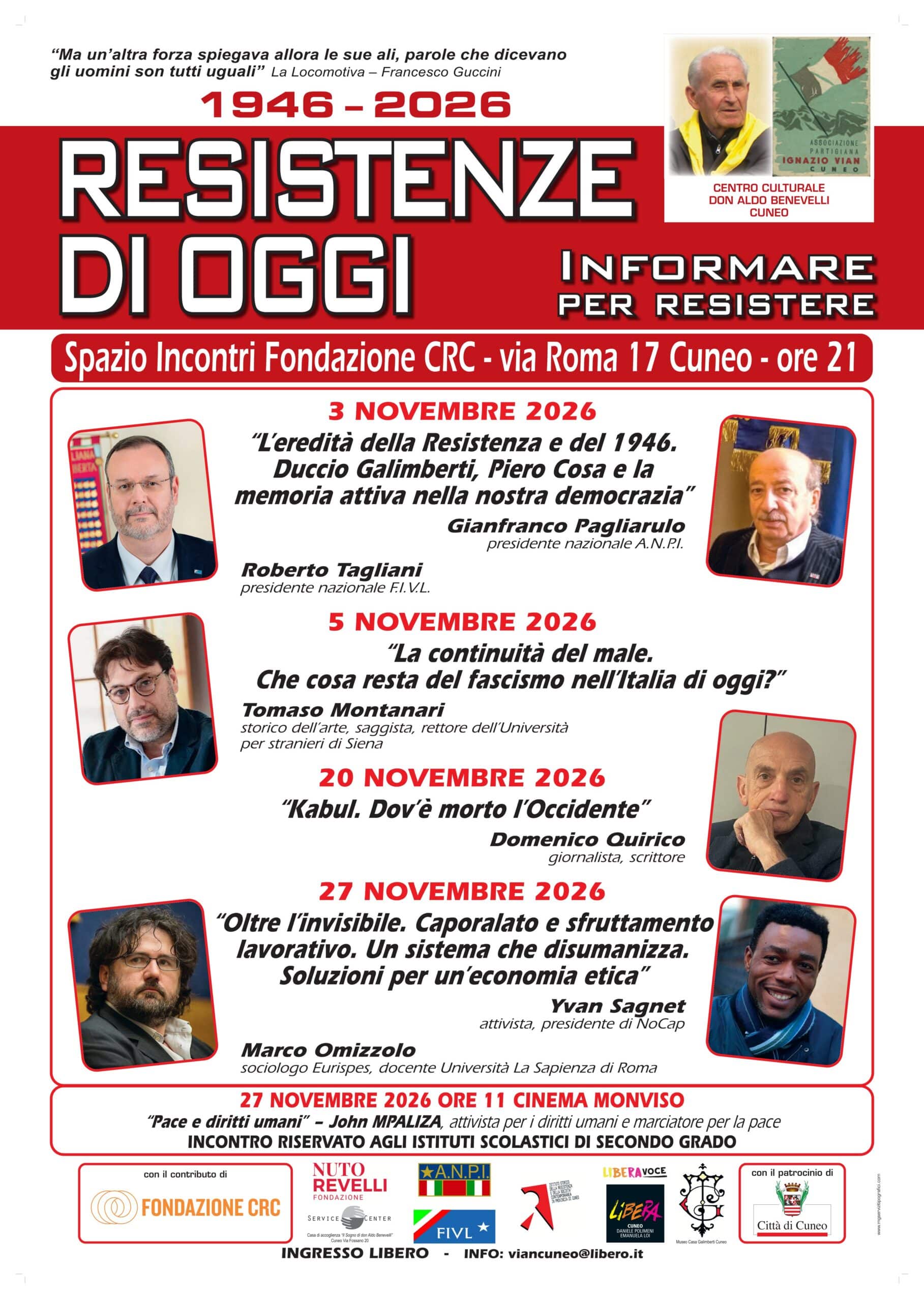
TODAY'S RESISTANCES – INFORMING TO RESIST” – FALL 2026
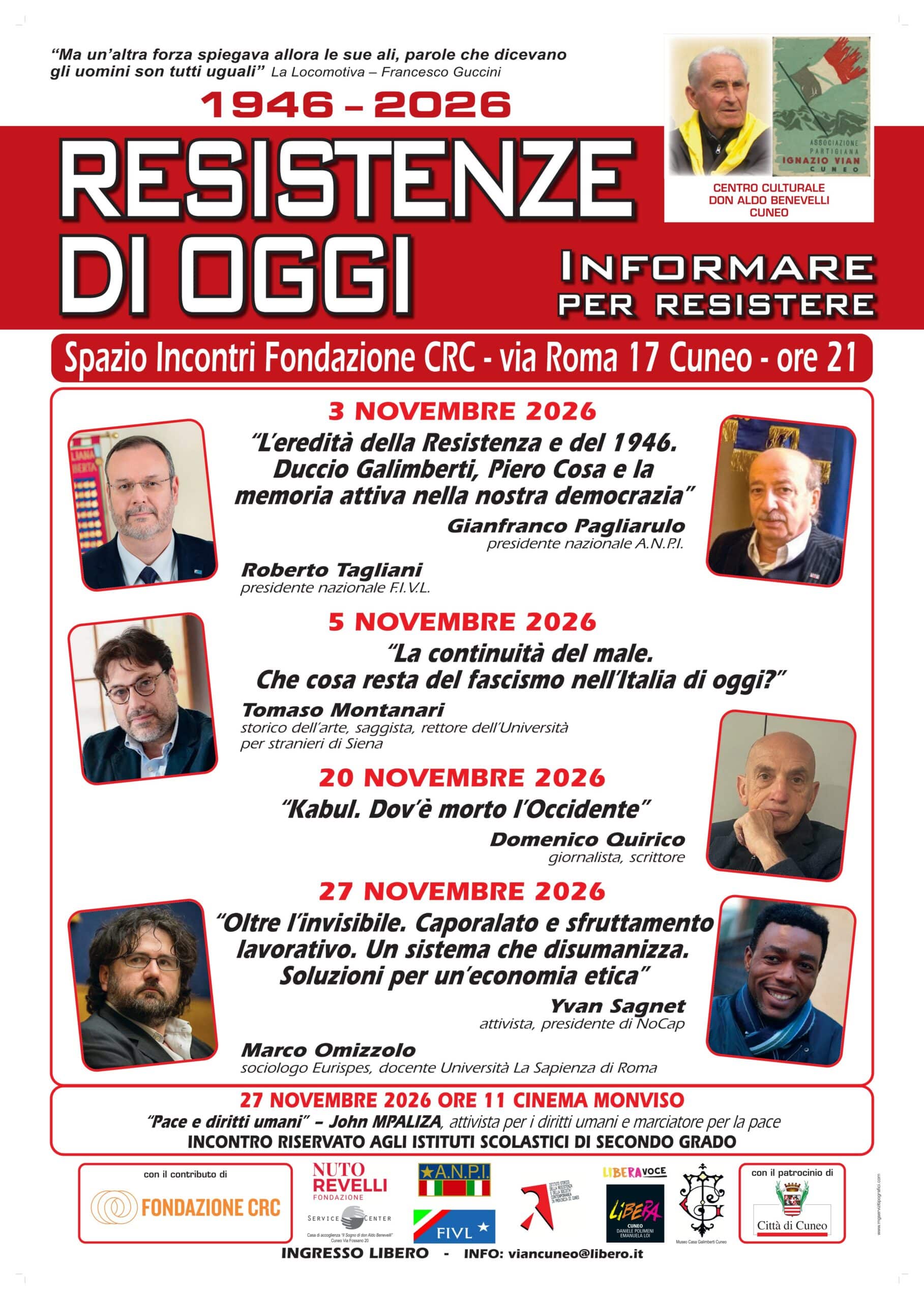
The “ Resistenze di Oggi – Informing to Resist ” events of the “ don Aldo Benevelli ” CULTURAL CENTER of the Ignazio Vian Partisan Association of Cuneo, federated with FIVL, are back.
On the occasion of the eightieth anniversary of the Italian Republic, in a world now saturated with inhumanity and marked by the resurgence of nationalism, the cultural initiative offers four moments of discussion and analysis between historical memory and the challenges of the present, recalling that freedom and democracy are a common good to be protected and implemented every day, and that anti-fascism is an indispensable pillar for the protection of equality, social justice, fundamental civil rights, peace, and the intrinsic and inalienable value of the human person, which precedes any national, ethnic, or social affiliation.
The cultural event, which will take place at the SPAZIO INCONTRI FONDAZIONE CRC, Via Roma 17, Cuneo, at 9:00 PM, will be an opportunity to focus on the human person and their inviolable dignity. This is because each of us is the guardian and promoter of our own dignity and that of others in our daily lives. Recognizing the dignity of others means giving them a name, a face, and the right to be heard without judgment. This is a simple act of love and civil resistance, and we must not remain indifferent in the face of abuse, discrimination, or disrespect.
Tuesday, November 3, 2026, 9:00 PM – “The Legacy of the Resistance and 1946: Duccio Galimberti, Piero Cosa, and Active Memory in Our Democracy”
with Gianfranco Pagliarulo, national president of ANPI
and Roberto Tagliani, national president of FIVL
Duccio Galimberti, whose birth anniversary is celebrated 120 years ago, a hero of the Resistance and recipient of the Gold Medal for Military Valor, left behind a highly relevant ideal and political legacy, with his coherence between ideas and actions, his active defense of rights and legality, the centrality of the rule of law, his European vision, and his commitment to overcoming nationalism.
Piero Cosa, who left us on November 5th, 30 years ago, Commander of the partisan band that went down in history as the "rebel" band of the Pesio Valley, remains today a point of reference for ethics and civility for his humanity, moral rigor, and rejection of violence for its own sake.
The example of the Resistance of 1943-1945 urges us to rediscover our own sense of responsibility, through active participation, so as not to give in to indifference and to oppose today's world marked by growing conflicts, where authoritarian regimes exploit new technologies to perfect social control and disinformation, along with the rhetoric of "us against them," which becomes the primary tool for consolidating internal consensus and justifying the suppression of civil and political rights, where economic insecurity, perceived inequality, and the loss of centrality of the middle class in Western democracies fuel demands for greater protection, while distrust of institutions has opened the way for charismatic leaders who promise quick and direct solutions, often at the expense of democracy itself.
Thursday, November 5, 2026, 9:00 PM "The Continuity of Evil. What Remains of Fascism in Today's Italy?"
With Tomaso Montanari, art historian, essayist, full professor of Modern Art History, and Rector of the University for Foreigners of Siena. His studies focus particularly on 17th-century art and cultural heritage, themes he has always intertwined with civic and political engagement. Among his latest books: Libera Università, Per Gaza, and La continuita del male- Perché la destra italiana è ancora fascista.
Reading Tomaso Montanari's latest book – TheContinuity of Evil – means coming face to face with everything our anti-fascist Constitution sought to erase: race, nationalism, identity, patriarchy, inequality, authoritarianism.
Tomaso Montanari explains what remains of fascism in today's Italy by analyzing the language and mentality of current leaders and activists of the Italian right. They are obsessed with the defeat of fascism, neither regretting nor denying the past, and are seeking, even with revisionist historical theories, to construct a new reality based on Mussolini's dictatorship.
For Tomaso Montanari, calling things by their name becomes a democratic necessity to understand what is happening in that dark thread of continuity from the postwar period to the present day. This idea of a nation led by a leader with full powers, whose borders must be defended, even violently, against foreigners, cannot tolerate conflict within its borders and defends inequality by contesting the legitimacy of social conflict, with a patriarchal conception of the family and the need to "return women to their place," that is, to bear children in service to the country, along with the goal of shaping and standardizing "true Italians" by strengthening order and discipline in schools, including through new sanctions and punishments, and by defending "the race" by creating fears against immigrants who would steal Italians' jobs and "identity.".
To break this “continuity of evil” and exercise a nonviolent right to resist, Tomaso Montanari tells us that “it is urgent to begin implementing the project of the Constitution of the Republic, taking the human person as our supreme compass (...) and it is even more urgent to learn to love people who are different from us: equal in rights and unique, unrepeatable, uncontrollable and free in their marvelous diversity”.
Friday, November 20, 2026, 9:00 PM, “Kabul, Where the West Died”
with Domenico Quirico, editorialist for “La Stampa”. He was head of the Foreign Service and correspondent from Paris. As a war correspondent from the world's most dangerous fronts, he covered the major conflicts of our time and African events of the last twenty years, particularly the Arab Spring. He was a prisoner of al-Qaeda in Syria and of Gaddafi's militiamen in Libya. He has won prestigious journalism awards. In 2024 he won the International Flaiano Prize for Lifetime Achievement in the Journalism section. He is the author of numerous publications, including the latest “Kalashnikov” (2024) and “The Four Jihads. The Clash between Islam and the West from Napoleon to Hamas” (2025). His latest book on Afghanistan and the End of the West will be released in a few days.
Situated at the crossroads of Central, South, and West Asia, Afghanistan, a land of great conquests, was already in the interests of England in the 19th century, which, through the British Empire and the East India Company, attempted to subjugate and control it. A protracted conflict went down in history as the "Great Game ," a heated geopolitical rivalry between the British Empire and Tsarist Russia for supremacy in Central Asia. Afghanistan was then invaded by the Soviet Union in 1979. With the resistance of the mujahideen, supported by the United States, Pakistan, and Saudi Arabia, the Soviets withdrew in 1989, and in 1996, the Taliban took control of Kabul after a civil war. Following the September 11, 2001, attacks and the refusal to hand over Osama bin Laden, the Taliban regime was overthrown by a US-led coalition that established a presidential republic, but in August 2021, with the withdrawal of NATO troops, the Taliban regained control of the country.
For Domenico Quirico, the withdrawal from Kabul and the Taliban's return to power represent the triumph of militant Islam over a weary and empty Western civilization. Not a simple tactical mishap, but the definitive symbol of the West's political, moral, and cultural decline.
"You Westerners have the clocks, we have the time," a famous Afghan adage that Quirico often summarizes to say that while the West thinks in terms of electoral cycles, immediate economics, and polls, radical Islam, by contrast, thinks in millenarian, religious, and community terms. Against the idea of belonging and the spirit of Islamic martyrdom, cutting-edge technology and billions of dollars spent by the West are worthless.
The idea of transforming Afghanistan into a liberal democracy through drones and bureaucracy was thus a colonial illusion by the West, which created a corrupt puppet government in Kabul completely alien to the culture of a population governed by archaic tribal and religious logic. As soon as NATO troops withdrew, everything collapsed within hours, precisely because it lacked popular roots.
For Domenico Quirico, the West's real defeat is moral in nature because it has abandoned millions of Afghans (especially women) to their fate after having deluded them for twenty years with rights and freedoms, women and men thrown away by the West when the operation no longer proved advantageous.
No longer believing in anything but material well-being, the West has nothing left to counter the strength of those who possess absolute faith, a sense of sacred belonging, and a communal destiny.
For Quirico, the victory of the Taliban's Islam played a role in the current global disorder of wars, exterminations, and nationalisms, with a cultural and spiritual capitulation of the West, too weak to fully defend its ideas.
Friday, November 27, 2026, 9:00 PM "Beyond the Invisible. Gangmastering and Labor Exploitation. A Dehumanizing System. Solutions for an Ethical Economy"
With Marco Omizzolo, a sociologist at Eurispes and a professor at Sapienza University of Rome, he has been analyzing and exposing forms of agro-mafia and gangmastering in the field for years. He has received the Order of Merit of the Italian Republic for his civil commitment to defending the rule of law and for his reporting on mafias in Italy and abroad, gangmastering, international trafficking, and labor exploitation.
and Yvan Sagnet, an engineer and activist who led the historic 2011 Nardò farm workers' strike, founder and president of NoCap, an association that promotes ethical supply chains and a concrete alternative to illegal labor and exploitation; he was awarded the honor of Knight of the Order of Merit of the Italian Republic for his contribution to combating and exposing the exploitation of farm workers.
The fight against labor exploitation is one of the fundamental pillars of the Italian Constitution, both in its fundamental principles and in the protection of workers' rights.
However, labor exploitation and gangmastering are among the deepest and, unfortunately, still dramatically present scourges of our productive and social system, manifesting themselves throughout Italy in various forms and systematically affecting both foreign and Italian workers.
The province of Cuneo holds a sad record: it was in the Granda that the first conviction for gangmastering was reached in Northern Italy.
Marco Omizzolo and Yvan Sagnet tell us their stories and the stories of women and men, laborers, migrants, and Italians who rebel against the slavery of their masters. Beautiful stories with happy endings, but also very sad and thought-provoking ones. Now that slavery is illegal, the data tells us that there have never been such high levels of exploitation in the world.
The last, the invisible, are the many Italian citizens who live in extremely precarious situations and diminished rights, accepting paltry wages or irregular contracts due to the lack of alternative employment. They include the many migrant workers who, in recent years, due to major changes in immigration regulations, find themselves without residence permits or in extremely precarious situations, but also the "so-called regular" workers who, nevertheless, do not escape a system of exploitation, starvation wages, and lives in dilapidated housing, and who accept work as "servants.".
Human trafficking with an extremely high level of brutality. A heavy psychological and social impact due to isolation and dependence on the gangmaster, especially for those living in ghettos like Borgo Mezzanone.
Anyone who chooses to break this gangmaster system and takes a public stand against the phenomenon faces systematic intimidation strategies aimed at imposing silence through fear.
To a system of gangmasters that is also intertwined with criminal organizations, because the mafias not only tolerate gangmasters but also integrate them by controlling the entire agri-food supply chain, Yvan Sagnet's NoCap Association responds with a concrete alternative in terms of employment and by demonstrating, through its supply chains, that it is possible to produce quality goods at affordable prices while respecting the environment and workers' rights.
Friday, November 27, 2026, 11 a.m. at the Monviso Cinema in Cuneo
Meeting RESERVED for secondary schools with
JOHN MPALIZA, human rights activist and peace marcher
In collaboration with Libera Cuneo Libera Voce
“Resistenze di Oggi – Informing to Resist” has the patronage of the CITY OF CUNEO and the contribution of the CRC FOUNDATION.
Supporting the initiative are: Ignazio Vian Partisan Association of Cuneo, FIVL-Italian Federation of Freedom Volunteers, Historical Institute of the Resistance and Contemporary Society of the Province of Cuneo, Libera Voce-Libera Cuneo, Nuto Revelli Foundation of Cuneo, Provincial ANPI of Cuneo, Casa Galimberti Museum of Cuneo, Temporary Shelter “Il Sogno di Don Aldo Benevelli” Cuneo, Via Fossano 20.
All meetings are free. For information: viancuneo@libero.it